
Taking Kids to a Corn Maze in Dixon, California: What to Know Before You Go
Planning a Dixon corn maze outing? Here’s how to check the essentials, judge the walking demands, and keep the adventure manageable for kids.
· 9 min read
Planning a Dixon corn maze outing with kids? Start by checking the attraction’s official website for current operating dates, admission details, and maze options, then plan around your youngest child’s walking stamina. The best family visit is not necessarily the one where everyone reaches the finish. It is the one where the challenge stays fun and you have a clear plan for taking a break or leaving.
This guide focuses on planning a corn maze visit in Dixon, California, rather than reviewing a particular attraction. No venue-specific hours, prices, routes, or facilities are confirmed here. Use the advice below to decide what will work for your crew and what to ask before heading out.
Check the essentials before you commit
Before promising the kids a maze adventure, find the official website for the attraction you intend to visit. Check that its information applies to your planned date, not a previous season. A search result, saved social post, or old review can be useful for discovery, but it should not be your final source for booking details.
Make a quick checklist of the information you need:
- Operating dates and hours: Confirm your intended day, plus any separate last-entry time.
- Tickets: Check current prices, age categories, reservation requirements, and what admission includes.
- Maze choices: Ask whether there are shorter routes or different challenge levels.
- Entry rules: Verify whether you can leave the maze and return, or leave the site and reenter.
- Weather policies: Read the cancellation, closure, refund, and rescheduling terms.
- Facilities: Check parking, restrooms, handwashing, drinking water, and food arrangements.
If an answer affects whether your family can visit comfortably, contact the attraction directly. Do not assume a feature exists simply because you have seen it at another corn maze.
Think of the maze as a walking outing
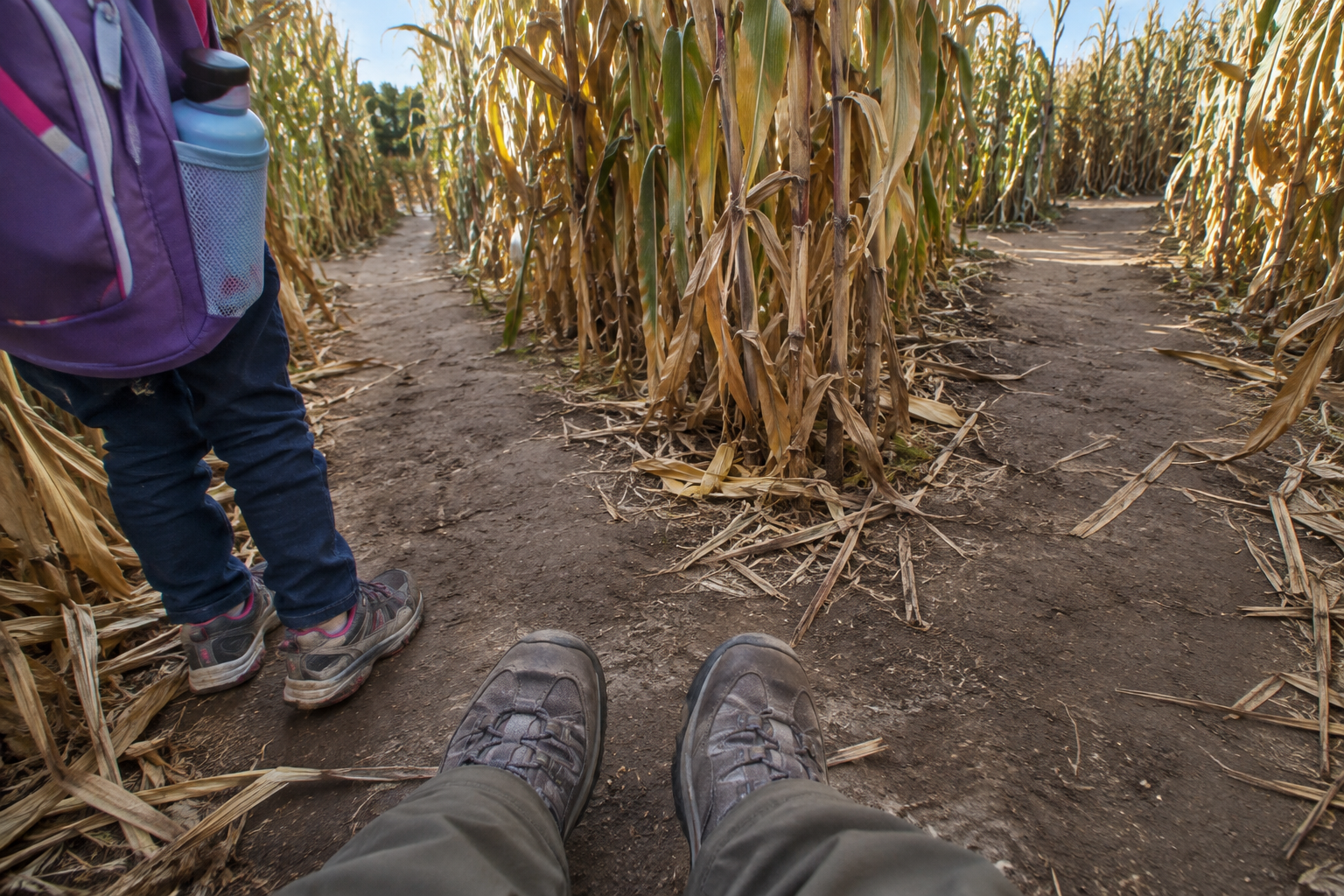
A maze combines walking with decision-making. For planning purposes, allow for wrong turns, retracing your steps, and pauses to agree on a direction. That makes the experience different from a straightforward walk with a visible destination.
Ask about route length, terrain, and any estimated completion time. Treat an estimate as guidance rather than a promise for your family. A child who wants to study every junction will move differently from one who wants to hurry toward the exit.
Use your child’s comfortable walking ability as the starting point, not their best-ever effort. Consider how they handle uneven ground, standing while adults make decisions, and walking when they cannot see how much farther they have to go. Also leave some energy for getting from the maze back to the car.
If you are uncertain, ask whether there is a shorter option and how visitors exit before finishing. Do not rely on being able to take a shortcut through the corn.
Choose a challenge that suits your children
Age can help guide your planning, but temperament matters too. One child may love choosing a path without knowing where it leads. Another may find the same uncertainty upsetting. Talk about the basic idea before the visit: you will follow paths, make choices, and sometimes turn around.
For younger children, keep the goal simple. They might enjoy picking a direction at a junction or spotting a marker more than solving the whole route. If a shorter maze is available, consider starting there rather than treating it as a fallback.
Older kids may enjoy navigating, keeping track of turns, or working out a strategy. Give them a real role while keeping adults responsible for safety and the group’s energy. Avoid making one child the navigator for the entire visit unless everyone is happy with that arrangement.
With mixed ages, choose the experience the least confident walker can manage. Splitting into separate groups is an option only if each group has appropriate adult supervision and you have confirmed how and where to meet afterward.
Plan your timing around family energy
Choose from the attraction’s confirmed entry times with your child’s usual routine in mind. A slot that overlaps with a nap or pushes lunch too late may be less appealing once you picture the whole day. Include the drive, parking, ticket checks, and a restroom stop in your plan.
Check the forecast close to your visit and consider the conditions for your intended time outdoors. Look at temperature, wind, and the possibility of rain, then adjust clothing and supplies accordingly. Check the attraction’s own updates if conditions could affect opening or access.
If you want a daylight visit, make sure your planned arrival leaves enough daylight for the experience you have chosen. If an attraction advertises an evening experience, verify its lighting, age guidance, and whether it includes any scare elements before booking.
Keep the next part of your day flexible. A tightly timed meal reservation or another prepaid activity can turn a few wrong turns into unnecessary pressure.
Pack for comfort without overloading yourself
Think about what you would want on a family walk, then check the attraction’s rules about bags, outside food, and drinks. A small, comfortable backpack is more practical than carrying several loose items while helping a child navigate.
- Comfortable, secure shoes: Choose footwear your child has already worn successfully for walking.
- Water: Check what you may bring and whether refills are available.
- Weather-appropriate clothing: Bring useful layers and sun protection based on the forecast.
- Snacks, if permitted: Decide where you can stop to eat without blocking a route.
- Personal essentials: Carry required medication, wipes, and any supplies your child routinely needs.
- A charged phone: Save booking information and relevant visitor instructions before arrival.
- A change of clothes: Consider leaving one in the car if the forecast or ground conditions warrant it.
Keep the items you might need inside the maze with you, rather than assuming a trip back to the car will be easy. Equally, leave unnecessary extras behind so carrying the bag does not become its own endurance test.
Verify stroller and accessibility details directly
Do not assume that an outdoor family attraction has a stroller-friendly or wheelchair-accessible maze. Ask about the actual route, not just whether a mobility device is allowed through the entrance.
Useful questions include whether paths are firm or loose, whether there are slopes or narrow sections, and whether current conditions have changed access. Ask about the distance from parking to the entrance, accessible restrooms, and places to rest outside the maze.
For stroller users, confirm whether the attraction recommends a particular type and whether there are sections where pushing becomes difficult. If you are considering a child carrier instead, use one appropriate for your child and comfortable for the adult who will carry them.
For anyone who needs a predictable route or a quick exit, ask what information can be provided in advance. Specific answers about surfaces, distances, and exit procedures are more useful than a general description such as “family-friendly.”
Set a few simple rules before entering
Use a restroom before entering if facilities are available, offer a drink, and read the posted instructions together. Ask staff how to get assistance and how to leave early. If a map or visitor guidance is provided, take a moment to understand it before heading down the first path.
Keep your family rules short enough for children to remember:
- Stay with the group and keep the supervising adult in sight.
- Stop at junctions until everyone catches up.
- Stay on designated paths and do not cut through the corn.
- Tell an adult when you need water, a restroom, or a break.
Follow the attraction’s instructions for what to do if someone becomes separated. Make sure children know which adults are responsible for them. Do not make phone contact your only reunion plan, since a phone is not a substitute for staying together.
Take a photo of any relevant instructions if permitted. It is easier to check a saved instruction than to try to remember it while managing a tired child.
Keep the pace playful, not competitive
Once inside, let the experience be about exploring rather than beating a clock. Take turns choosing directions, or give children small jobs such as checking the map when one is available. An adult can keep track of the route while still letting kids feel involved.
Use natural pauses to check how everyone is doing. Ask specific questions: “Do your feet feel okay?” or “Would you like some water?” These are often more useful than asking whether everyone is having fun.
Wrong turns do not need to become mistakes someone gets blamed for. Try language such as, “We have checked that path, so now we can try another one.” If navigation starts causing arguments, switch the decision-maker or let an adult take over for a while.
Take breaks only where safe and permitted, keeping paths clear for other visitors. If your child starts struggling, shorten the challenge rather than offering one more turn repeatedly. Finishing is optional. Keeping the outing manageable is the priority.
Have a clear plan for leaving early
Before entering, find out whether you must retrace your steps, use marked exits, or request staff assistance to leave without completing the maze. Do not assume an exit will be nearby when someone reaches their limit.
Agree with the other adults on what would prompt you to stop. A child who becomes distressed, feels unwell, or cannot comfortably keep walking needs a change of plan, not encouragement to push through for the sake of finishing.
Leaving can still be a positive ending. You might say, “We explored lots of paths, and now we are ready for a rest.” Avoid presenting an early departure as failure, especially if you want your child to feel confident trying another outdoor adventure later.
Keep any post-maze plans simple. A rest and a drink may be all your family wants before the drive home.
Budget for the whole outing
Check current admission costs on the official site and look at the final booking total before paying. Verify whether parking, other activities, or any booking fees are separate. If there are ticket bundles, compare their actual inclusions with what your family plans to do.
Ask about age-based admission rules rather than assuming younger children enter free. Check food options and outside-food policies so you can decide whether to buy something on site or plan a meal elsewhere.
Set expectations with kids before arriving about any optional purchases. Keeping the maze as the main activity can make the day easier to budget and less tiring. You do not need to add every available extra to make the outing feel worthwhile.
Frequently asked questions
When is the Dixon corn maze open?
Check the official website for the specific attraction you plan to visit. Confirm current operating dates, hours, and last admission for your chosen day. This guide does not confirm a venue’s schedule.
How long does a corn maze take with kids?
There is no confirmed duration here. Ask the attraction about route length and estimated completion times, then allow for your children’s pace, wrong turns, and pauses. Find out how to leave early before entering.
Is a corn maze suitable for toddlers?
That depends on the route, conditions, and your toddler’s needs. Check for shorter options, stroller suitability, restroom access, and exit procedures. Plan around what your child can comfortably manage rather than expecting them to complete the main maze.
Can we bring a stroller or wheelchair?
Verify this directly with the attraction. Ask about path surfaces, widths, slopes, and current ground conditions, as well as access to parking and restrooms. Permission to bring a device does not by itself establish route suitability.
Are corn mazes scary for children?
Check how the specific experience is described and whether it includes scare elements. Even without those features, some children may dislike uncertainty or limited views along a path. Explain the activity beforehand and respect a request to stop.
What if we get lost or need to leave?
Follow the attraction’s map, posted guidance, and staff instructions. Ask about assistance and early exits before entering. Stay on designated paths, keep your group together, and never create your own shortcut through the corn.