
Turn a Nearby Park or Nature Trail Into a Family Mini-Adventure
Find a local outdoor outing that fits your family, with tips for comparing trails, checking playgrounds and restrooms, and making nature exploration feel like an adventure.
· 7 min read
If you’re searching for things to do near me with kids, start with a nearby park or nature trail that matches your family’s energy, walking ability, and bathroom needs. A short path, a playground, and a few interesting things to notice can be enough for a satisfying outing. You don’t need a famous destination or an ambitious hike, just somewhere that makes getting outside feel manageable.
The trick is choosing the right kind of place before packing the bag. Use this guide to compare local options, check the practical details, and turn an ordinary walk into a small adventure with room for snack breaks and changes of plan.
Start with the outing your family needs today
Before opening a map, decide what would make this outing a win. Does your toddler need somewhere to wander? Does your older child want a challenge? Are you hoping for a stroller walk followed by a playground stop? Those answers are more useful than a long list of highly rated parks.
- For a low-energy day: Look for a compact park with a short walking route and somewhere to pause.
- For mixed ages: Prioritize a playground near a path so walking is only part of the plan.
- For curious explorers: Look for a designated nature trail with features such as trees, interpretive signs, or a viewing area, where confirmed.
- For confident walkers: Consider a longer route, but keep an easy turnaround option.
Choose one main activity and treat everything else as optional. “Walk to the big tree and play afterward” gives children a clear plan without turning the afternoon into a checklist.
Find nearby parks with useful information
A map search can help you build a shortlist, but check the official park, city recreation, county parks, or land manager’s website before choosing. Search phrases such as “park with playground near me,” “paved nature trail near me,” or “park restrooms near me” can narrow the possibilities.
Look for a trail map, facility list, accessibility information, current alerts, and any rules relevant to your visit. Confirm opening hours, admission or parking charges, and reservation requirements on the official site rather than assuming that every outdoor space is always open or free.
Recent visitor photos can help you picture the setting, but they aren’t a substitute for current official information. Save the correct entrance and trailhead before leaving. A large park’s main map pin may not lead to the playground or walking route you want.
Compare trail difficulty beyond the distance
A short trail isn’t automatically an easy trail. Hills, loose gravel, exposed roots, stairs, and muddy sections can change how a walk feels. Read the route description as well as the mileage, and check whether the listed distance is one way or round trip.
- Surface: Is it paved, compacted gravel, boardwalk, or a natural surface?
- Slope: Does the description mention steep climbs, sustained hills, or steps?
- Layout: Is it a loop, or will you return along the same path?
- Exposure: Is shade described, and are there open sections?
- Exit options: Can you shorten the walk without taking an unofficial shortcut?
An out-and-back route lets you turn around when energy dips. A loop offers changing scenery, but check its full length before committing. Pick for the least confident walker, not the adult who could comfortably cover twice the distance.
For strollers or mobility devices, look for specific access details, including surface, grade, width, and barriers. “Easy” and “accessible” aren’t interchangeable. If the description leaves an important question unanswered, contact the park office.
Check playground access and restroom details
A playground can give reluctant walkers something to look forward to, but proximity matters. Check whether it’s beside your planned route, across a road, or in another section of the park. Look for age guidance where available and think about whether you can supervise children with different play needs from the same area.
Restrooms deserve their own check. Confirm their location and any posted seasonal closures or access limitations. Don’t assume a restroom symbol means the facility will be available whenever you visit, or that it includes a changing station.
Use this quick comparison when two parks both look promising:
| Priority | What to check |
|---|---|
| Short, manageable walk | Distance, surface, slope, and turnaround options |
| Playground break | Location relative to the trail and suitability for your children |
| Bathroom access | Confirmed availability and distance from your route |
| Nature exploration | Designated paths, viewing spots, or interpretive features |
| Easy arrival | Correct entrance, parking information, or transit access |
Choose convenience over novelty when it matters. A familiar park with confirmed restrooms may suit your family better than a new trail with unclear facilities.
Give the walk one simple nature mission
You don’t need a worksheet or specialist equipment to make a walk interesting. Offer one small mission, then let children’s discoveries guide the pace. The goal is noticing, not finishing a scavenger hunt as fast as possible.
- Find three textures: Spot rough bark, a smooth stone, and a feathery-looking plant without picking or disturbing anything.
- Listen like a detective: Pause somewhere safe and compare the sounds you hear.
- Search for shapes: Find a curved branch, a pointed leaf, or a round pebble along the path.
- Watch for movement: Notice swaying grass, drifting clouds, or birds from a respectful distance.
- Choose a landmark: Let each child pick a memorable feature to recognize on the return walk.
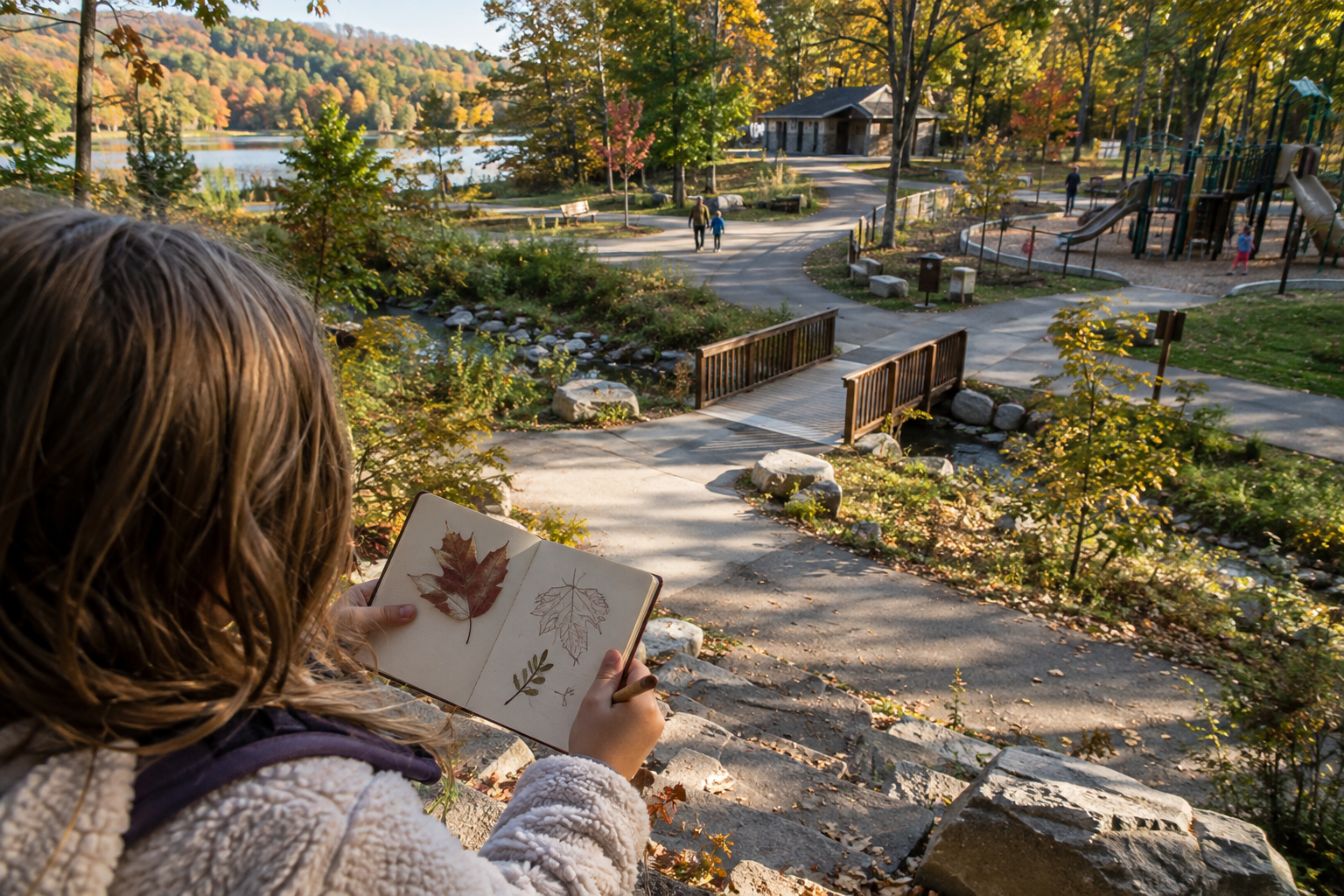
Younger children may enjoy pointing and naming colors. Older kids can sketch observations, take photos, or think of questions to investigate later. If nobody wants a mission, skip it. Unstructured wandering within the designated area is a perfectly good plan.
Leave natural objects where you find them, follow collection rules, and never taste unknown plants or berries. Keep wildlife watching hands-off and give animals space.
Pack for comfort without carrying the whole house
Match your supplies to the route, weather, and your children’s needs. Even a short outing is more pleasant when you aren’t relying on an unconfirmed water fountain or concession stand.
- Water for everyone and a manageable snack.
- Comfortable footwear suited to the trail surface.
- Weather-appropriate layers and sun protection.
- Any needed medications and basic first-aid supplies.
- A charged phone and a saved trail map.
- Diapering supplies or spare clothes, if relevant.
- A small bag for carrying out trash.
Check the forecast and official trail alerts before heading out. Adapt or postpone the outing if heat, storms, poor air quality, or trail conditions make your plan unsuitable. Tell someone where you’re going if your walk takes you away from busy park areas.
Build in an easy finish
Start with a bathroom stop if facilities are available, then explain the plan in simple terms. Set boundaries around staying together, trail junctions, roads, and water before children get absorbed in exploring.
Make the first part of the walk deliberately easy. Stop at the first interesting discovery rather than pushing toward a distant goal. Watch for slowing steps, repeated requests to be carried, or fading enthusiasm, and turn back while everyone still has energy for the return.
A playground stop or snack can round out the visit, but neither needs to be earned by completing a route. Ending early isn’t a failed adventure. Before leaving, ask everyone for one favorite discovery. That tiny recap can give you a reason to return and notice what has changed.
Frequently asked questions
How do I find things to do near me with kids outdoors?
Start with local parks and recreation websites and map searches for playgrounds or nature trails. Compare walking difficulty, restroom availability, and the distance between facilities. Verify the details that matter to your family on the official site before traveling.
How long should a family nature walk be?
Choose a route that feels comfortably within your least confident walker’s ability, with time for stops. There’s no need to hit a mileage target. A short out-and-back walk can be a useful first choice because you can turn around early.
Can I take a stroller on a nature trail?
Check the specific trail’s surface, slope, steps, and barriers before deciding. A nature trail label doesn’t tell you whether a stroller will work. Use official accessibility details, and contact the managing organization if the route description is unclear.
What if the park has no restrooms?
Choose another location if reliable bathroom access is essential for your family. Otherwise, plan a bathroom stop before arrival and keep the visit manageable. Don’t rely on nearby businesses having public facilities unless you’ve confirmed access.
How can I make the same park interesting again?
Change the mission rather than the destination. Look for shapes on one visit, listen for sounds on another, or let a child lead along a familiar designated route. Returning to the same place also gives kids a chance to notice seasonal changes.